
Custom Jewelry Manufacturing Since 2010: A Buyer's Checklist
TTT Jewelry has been manufacturing for other brands since 2010, which is 15+ years of OEM/ODM work on one published sequence of eight factory steps. The checklist below uses only what the factory states about itself: minimums of 50, 100 and 100+ pieces, CAD in 3–4 weeks of production on top of a 25–30 day sampling window and 48-hour CAD.

Key takeaways
- Fifteen years of OEM/ODM experience is a claim about repeatability; the checkable part is the published process, minimums and windows.
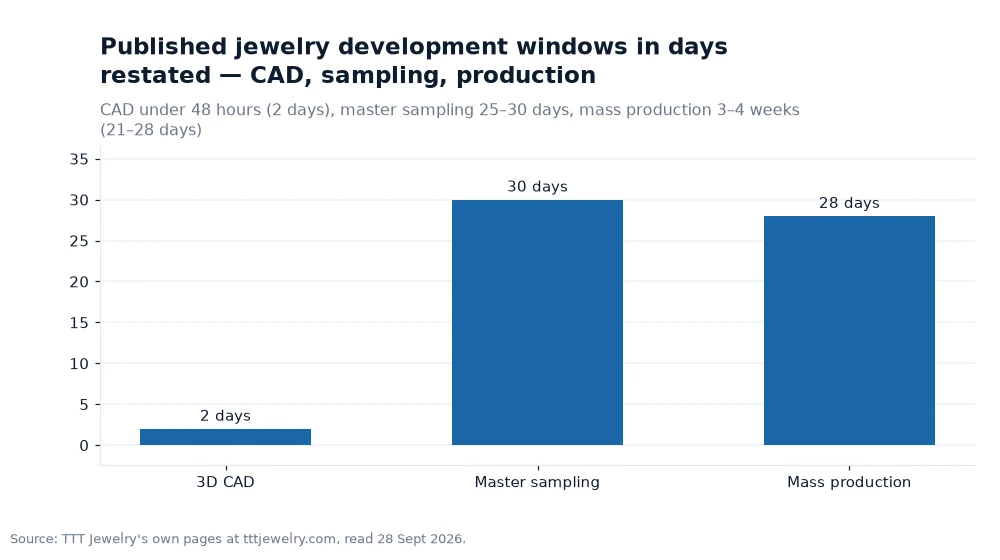
- 3D CAD lands inside 48 hours, sampling takes 25–30 days, and mass production runs 3–4 weeks.
- Six customisation options cover base material, plating, chains, stones, hallmarks and packaging.
- Three documents are worth requesting by name: The ISO 9001:2015 certification, an audited BSCI social-compliance programme and REACH compliance on lead, cadmium and nickel.
What 15+ years of OEM/ODM work does and does not tell you
A long trading history says the factory has survived enough batches to keep going. It does not say anything about your design, your scale or your finish, and a checklist that stops at the founding date is not a checklist.
What can be checked is what the factory publishes about how it works: eight named steps from concept design to delivery, six customisation options, and three windows. Those items can be compared between suppliers in an afternoon, which is the only test that matters before a first order.
The checklist, in the order it should be asked
Start with the process, because it decides whether the answers that follow come from a bench or from a brochure. Then the minimum for your base metal, because it decides whether a design is viable at all. Then the two windows, CAD and sampling, since they decide the launch date. Finish with markings and packaging, which are the items most often left until the carton is already being packed.
| Checklist item | Published answer | If the answer is blank |
|---|---|---|
| Process steps | Eight, from concept design to delivery | Ask which ones are subcontracted |
| Minimum per design | 50 / 100 / 100+ pcs by base material | Assume the highest of the three |
| CAD turnaround | Under 48 hours with renderings | Ask who does the drawing |
| Sampling window | 25–30 days, five operations included | Ask what the window excludes |
| Inspection point | 100% before packing | Request the inspection note |
Turning the windows into days you can plan against
Weeks and months hide the arithmetic, so put everything in days. The CAD stage at under 48 hours is under 2 days. The master sample at 25–30 days is 25 to 30 days. Mass production at 3–4 weeks is 21 to 28 days.
Laid end to end, that is between 48 and 60 days of factory time from an approved sketch to a shipped carton — roughly seven to nine weeks once your own approval time is added at the CAD and sample gates.
Worked example: a first order in days
Take the fast ends first: 2 days of CAD plus 25 days of sampling plus 21 days of production is 48 days. Now the slow ends: 2 + 30 + 28 = 60 days. The gap between a smooth order and a slow one is 60 − 48 = 12 days.
Twelve days is roughly the same as the sampling window's own spread of 5 days multiplied by two, which is why the sample gate is where a schedule is won or lost. It is also why a design change requested after approval costs more than one requested at the CAD stage, where the same change takes hours instead of days.
The documents that back the checklist
Three documents turn a checklist into a supplier file. An audited BSCI social-compliance programme, the ISO 9001:2015 standard and REACH limits on lead, cadmium and nickel, with the plating finishes stated as compliant with REACH and CA Prop 65 standards.
Four platings: 14K, 18K or 24K gold, and rhodium, with silver and brass sealed with anti-tarnish e-coating and PVD on stainless steel.
Where a first order should start
Start with one design in one material and let it run through all eight steps. A single piece exercises the CAD review, the sample approval, the mould, the plating route and the final inspection, and it exposes any gap in the process at the smallest possible scale.
Then scale the second order rather than the first. The published minimums are per design, so a second design in the same material carries its own 50, 100 or 100+ pieces rather than sharing the first design's run.
How the checklist changes on a repeat order
Four items survive intact: minimum per design, marking, packaging and the inspection point. Two change: the CAD stage and prototyping disappear, because the mould already exists and the design is fixed.
That is the practical reward for buying from a maker rather than a reseller, and it is worth asking about explicitly. A B2B jewelry manufacturing partner that holds the mould can quote a repeat against casting, finishing and inspection alone, while an intermediary has to start again from the sketch.
The parts of the checklist a factory answers immediately
Some items are policy rather than production: a 24-hour response commitment, a dedicated 1-on-1 project manager, a 100% NDA and a flexible minimum policy. They cost nothing to answer, and the way they are answered tells you whether enquiries land with one person holding a file or in a shared inbox.
The production items behave differently. The eight steps, the six customisation options and the three windows are the ones that reveal where the reply came from: a helpful one names an operation on the floor, and a vague one names a capability on a slide.
Setting a 90-day plan against the published windows
Ninety days is enough room for a first order if the design is settled early. Reserve days 1 to 30 for your own design work and the CAD review, because 48 hours of drawing time sits inside a month that is mostly your own decisions.
Days 31 to 60 then hold the master sample at 25–30 days, days 61 to 88 hold 21–28 days of production, and the final two days cover the shipping booking. If a plan needs more than ten free days at the end, the design probably was not settled at day 30.
Frequently asked questions
What does manufacturing since 2010 mean for a new buyer?
It describes 15+ years of OEM/ODM production experience. The checkable part is the published process, minimums and windows rather than the founding date.
Which customisation options are available?
Six: Customisation covers base materials, plating and finishes, chains and findings, stones and accents, logos and hallmarks, and packaging.
What is the fastest a first order can move?
Under 48 hours for CAD, 25 days at the fast end of the sampling window, and 21 days of production, which is 48 days of factory time before shipping.
Running the checklist on a real supplier
Ask the five checklist questions in one email and compare the replies item by item. TTT Jewelry publishes all five, along with the OEM/ODM structure that explains who designs and who produces, and the frequently asked questions page covers the shorter versions of the same points. If your design is headed for a plated look, the brass jewelry manufacturing page is where the plated route and its minimum are explained.
The basis for every figure above — the eight steps in production plus the six customisation fields, followed by the per-piece inspection rule — is the client's own website at the tttjewelry.com address, which I read through on 28 Sept 2026. The three-way comparisons of minimums are mine, and nothing else here[1].