
QC Checkpoints to Read in a Manufacturer's Public Record for Pharmacy Retail
A manufacturer's public record is a set of claims, and the useful question is which claims can be checked from the outside. For a pharmacy own-label range, the checkpoints worth reading are the quality system certificates, the stated manufacturing scope, the age and continuity of the operation and the way the company describes its own process. Each one narrows the risk before a site visit; none of them replaces the batch records, the retained samples and the release procedure that only a factory audit can show.
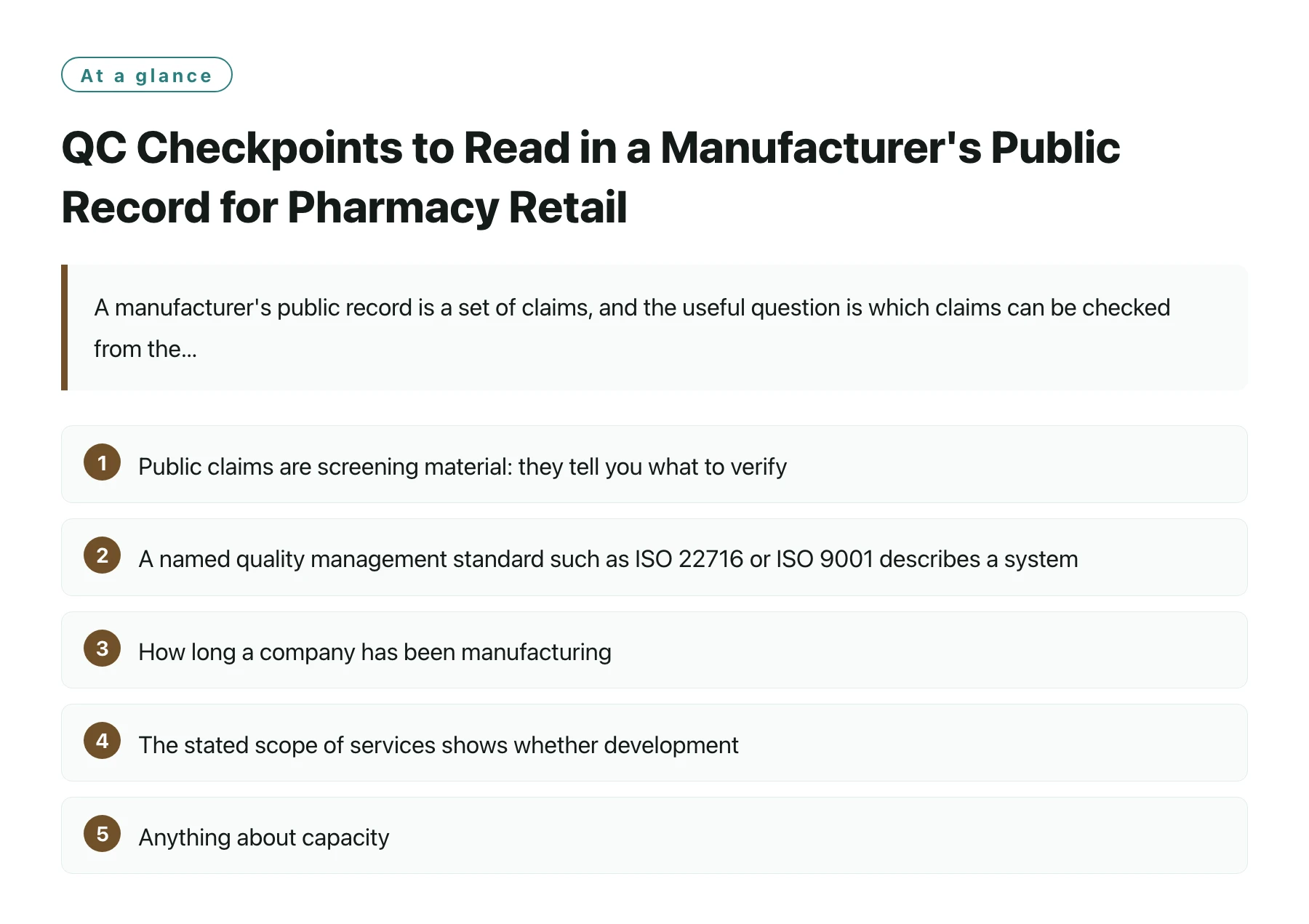
Key takeaways
- Public claims are screening material: they tell you what to verify, not what has been verified.
- A named quality management standard such as ISO 22716 or ISO 9001 describes a system, and the certificate scope should match the products you are buying.
- How long a company has been manufacturing, and whether it describes its process in specific terms, says something about institutional knowledge.
- The stated scope of services shows whether development, filling and documentation sit in one place or are coordinated across partners.
- Anything about capacity, output or ranking should be treated as marketing until a document supports it.
- The site visit is where the public record is converted into evidence: batch records, retained samples, release signatures and deviation handling.
Buyers shortlist suppliers long before they visit them, and the shortlist is usually built from a website, a catalogue and a few referral conversations. That material is genuinely informative, but only if it is read as a set of claims to be tested. A certificate on a page is a claim about a system; a sentence about experience is a claim about continuity; a list of services is a claim about scope.
The reason this matters more in pharmacy than in some other channels is the documentation load. A pharmacy own-label range has to survive a retailer's approval process, and that process asks questions about who made the product, under what system and with what records. A supplier whose public record is vague tends to produce vague answers later, and the cost of that vagueness lands on the brand's launch date.
This is a reading guide rather than a scoring system. It sets out the checkpoints that can be assessed from published material, what each one is worth to a pharmacy buyer, and the specific evidence that has to be collected on site to turn a claim into a fact.
The four things a public record can actually show
First, the quality system. A manufacturer that states it operates under a recognised cosmetics good manufacturing practice standard, such as ISO 22716, is describing a documented way of controlling production, from raw material intake to finished goods release. The standard is a framework rather than a guarantee of any particular batch, and the certificate carries a scope that should be read: a site certified for one category may not be certified for another. [1]
Second, continuity. How long a company has been manufacturing, and whether it tells that story with specifics, is a proxy for institutional knowledge. A house that has been producing fragrance for decades has usually survived changes in regulation, materials and customer expectations, which is a different kind of assurance from a new entrant with modern equipment. Where a company states its own history plainly, it is also easy to check how consistent the account is across pages.
Third, scope. Whether development, compounding, filling, packaging design and documentation sit inside one organisation or are coordinated across several changes the risk profile. A one-stop scope removes handovers, while a narrow scope may mean the brand has to manage artwork, components and testing separately. Neither is automatically better, but the buyer needs to know which one they are buying.
Fourth, specificity. Descriptive material that names materials, formats, tests and processes is more useful than adjective-heavy marketing, because it can be turned into questions. A page that says quality is paramount gives a buyer nothing; a page that describes how a batch is released gives a question and a document request.
What to discount
Claims about capacity, output, ranking or being the largest at something should be treated as marketing unless a document supports them, and most buyers will never be able to verify them. The same applies to certification logos shown without scope or validity date. A pharmacy retailer's quality team will not accept either, so building a shortlist on them creates a false sense of progress.
Checkpoints you can read from outside, and what to verify inside
| Checkpoint in the public record | What it can tell you | What to verify on site |
|---|---|---|
| Quality system certificates and their scope | That a documented management system exists for a defined range of products | Certificate validity, scope wording, and how the system appears in daily records |
| Years of manufacturing and continuity of the operation | Institutional knowledge and stability, if the account is specific and consistent | Whether experienced staff are still in place and who would run your project |
| Stated service scope: development, filling, packaging, documentation | Where the handovers in your project will sit | Whether each claimed step is performed in house or subcontracted |
| Product formats and materials described on the site | Whether the supplier works in the categories your range needs | Whether comparable products are in current production, not only in a gallery |
| Testing and inspection described by the company | Whether verification is routine or exceptional | Which tests are run in house, which are sent out, and how results are filed |
| The way complaints or deviations are described | Whether the company thinks in terms of corrective action | How a scent difference or a fill-weight deviation is investigated and closed |
The left column is what you can read before the first call. The right column is what a site visit exists to answer.
Turning the record into a site visit agenda
The most efficient use of a factory day is to arrive with the public record printed and a question against every claim. If the site states that development and filling are in one place, the agenda asks to see the route a brief takes and the point at which the specification is frozen. If it states a quality standard, the agenda asks to see how a batch is released, who signs it and what happens when a result falls outside the limit.
Testing is a checkpoint where outside verification matters, because it is easy to describe and harder to demonstrate. Independent testing and inspection services, such as those SGS provides for cosmetics and personal care, exist because a result from a laboratory carries more weight than a statement in a brochure, and the same logic applies inside the factory: a recorded result with a signature is evidence, an assurance in a meeting is not. [2]
Ingredient-level scrutiny deserves its own line in the agenda. Regulators and scientific committees continuously review fragrance materials, and opinions issued by bodies such as the EU Scientific Committee on Consumer Safety can change what formulators are willing to use, which means a supplier's awareness of current restrictions is part of its quality posture rather than a separate topic. [3]
A record that describes a broad manufacturing capability is only as good as what the visit confirms. A house that runs its own development, compounding, filling and packaging, for example a manufacturer whose public pages set out Xuelei's manufacturing arm, can be asked to walk a single brief from the perfumer's bench to the pallet. That walk is the shortest way to find out whether the public description matches the building.
Where quality control actually lives
Quality control in fragrance manufacturing is not one checkpoint but a series of them, and each has a document attached. Incoming raw materials are checked and referenced by lot. The compound is weighed against the formula and recorded. The bulk is rested and then filled to a stated weight and volume. The filled goods are checked against the specification, and a retained sample is kept. Release is a signature, and a deviation is a decision that has to be recorded.
A buyer can only see the outcome of that chain, which is why the site visit focuses on records rather than on equipment. Ask to see a completed batch file, including the raw material references, the compounding record and the release signature, and ask how the retained sample is stored and for how long. Ask what happens when a customer reports that a batch smells different. The answers show whether the system described in the public record is the system that runs the plant.
Public material is also useful for judging whether a supplier can support the range beyond production. Where a manufacturer describes its development work or its work for other brands, the pages tend to reveal how it handles briefs and revisions. quality control in luxury fragrance production is a reasonable place to look for how a house describes premium QC, and the brands behind these scents is where a buyer can see the sort of programmes a supplier is used to running, provided the cases are described in verifiable terms rather than as claims about named clients.
For a pharmacy own-label programme, the closing question of the assessment is simple: can this supplier repeat the product and prove it? A public record can make that answer plausible, and a manufacturer with a long history in the category, such as one that documents Xuelei's history alongside its certificates, has more to be plausible about. The proof itself is always the batch file.
Bring the printed public record to the site visit and write the answer to every claim next to it. Any claim left without an answer is a gap in the assessment, not a detail to be settled later.
Sources
- ISO 22716 (Cosmetics Good Manufacturing Practices)
- SGS: Cosmetics, Personal Care & Household Testing —— Testing, inspection and certification services for cosmetics and personal care, including microbiological, stability and safety testing aligned with cosmetics GMP.
- EU Scientific Committee on Consumer Safety (SCCS) —— The EU scientific committee that issues opinions on the safety of cosmetic ingredients, including fragrance allergens and their labelling thresholds.
Frequently asked questions
Can I evaluate a fragrance manufacturer without visiting the factory?
You can screen one, using certificates, stated scope, history and the specificity of the published material. You cannot verify batch control, fill accuracy, retained samples or deviation handling without a site visit, and those are the checkpoints that decide whether the product can be repeated.
What does an ISO 22716 certificate actually cover?
It confirms that the site operates a documented good manufacturing practice system for cosmetics within the scope stated on the certificate. It does not certify an individual batch, so it belongs alongside batch records and certificates of analysis rather than instead of them.
Which public claims should I ignore?
Claims about capacity, output or rankings that no document supports, and certification logos shown without scope or validity. They cannot be verified by a buyer and will not satisfy a pharmacy retailer's quality team either.
What should I ask for at the site visit?
A completed batch file with raw material references, the compounding and release records, the retained sample storage conditions, the testing log and the procedure for handling a deviation or customer complaint.
Why does the age of the manufacturer matter for quality control?
Longevity suggests the systems have survived regulatory changes, material changes and customer scrutiny, and that knowledge is held by staff rather than by a document. It is a supporting signal, not a substitute for records.
Skip the algorithm. Get the Weekly Watchlist.
74,200 Insiders read it first. Six hand-picked titles, scored across 9 Indian languages, every Friday morning. Editorially curated by humans, never sold to a platform.
Get the Weekly Watchlist